The Pink Tower is one of the most recognizable and beloved materials in Montessori classrooms—and for good reason. Simple, beautiful, and deceptively powerful, it lays a foundation for a whole lot of learning.
What is the Pink Tower?
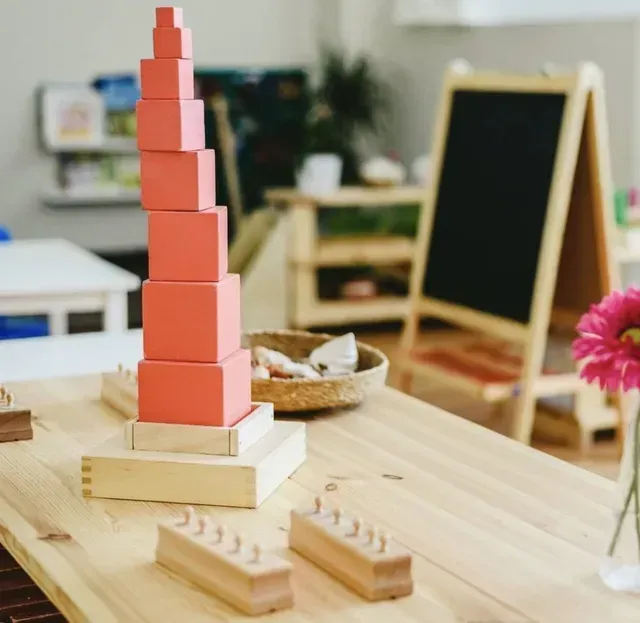
The Pink Tower consists of 10 pink wooden cubes, all the same color but varying in size, from 1 cm³ to 10 cm³. The child’s task is to stack them from largest to smallest, creating a tower that gradually narrows toward the top.
The Pink Tower matters because it helps children build the mental and physical foundations for learning—all through hands-on exploration.
At its core, it teaches children to perceive and understand size. By stacking cubes from largest to smallest, children refine their ability to visually discriminate dimensions, a skill essential for later work in math, geometry, and science.
It also supports movement and coordination. Carrying, placing, and balancing the cubes strengthens fine and gross motor skills while helping children develop control and precision.
Just as important, the Pink Tower nurtures concentration and independence. The material is self-correcting: if a cube is out of order, the child can see it immediately. This allows children to evaluate their own work, problem-solve, and persist without relying on adult correction—key elements of Montessori learning.
Although it belongs to the Sensorial area, the Pink Tower indirectly prepares children for mathematical thinking, including concepts of gradation, volume, and the base-ten system. It also lays groundwork for language, as children naturally begin to describe size relationships like bigger, smaller, largest, and smallest.Ultimately, the Pink Tower matters because it embodies the Montessori principle that simple, purposeful materials can lead to deep cognitive development. It respects the child’s capacity to learn through experience, discovery, and repetition—making it powerful far beyond its simplicity
Indirect Preparation for Mathematics
The Pink Tower supports mathematical development by giving children a concrete experience with size, order, and quantity before numbers are introduced. As children arrange the cubes from largest to smallest, they internalize concepts of gradation, comparison, and sequence, which are foundational to mathematical thinking. The uniform increase in all three dimensions helps children develop an intuitive understanding of volume and spatial relationships, laying groundwork for geometry and measurement. Because the material is self-correcting, children learn to analyze their work and problem-solve independently—skills essential for later success in math.